As more people become interested in where their food comes from, one question comes up frequently:
Is pastured Kunekune pork healthier than conventional pork?
The honest answer is that many factors influence pork quality, including genetics, diet, environment, management, and processing.
While no single breed can automatically be labeled "healthier," there are several reasons why consumers interested in nutrient-dense foods are increasingly choosing pasture-raised heritage pork.
Let's take a closer look.

What Is Pastured Kunekune Pork?
Pastured Kunekune pork comes from Kunekune pigs raised in outdoor environments where they have access to pasture and can express natural behaviors such as rooting, grazing, exploring, and socializing.
Kunekunes are a heritage breed originally developed in New Zealand and are known for:
- Friendly temperament
- Grazing ability
- Rich flavor
- Exceptional marbling
- High-quality fat
At Dos Lobos Ranch, our pigs are raised on pasture as part of our regenerative farming system.

What Factors Affect Pork Quality?
Many consumers assume all pork is the same.
In reality, pork quality can be influenced by:
Genetics
Different breeds naturally develop different levels of:
- Marbling
- Fat deposition
- Muscle characteristics
- Growth rates
Kunekunes are known for developing more intramuscular fat than many commercial breeds.
To learn more about our standards for breeding, check out Our Kunekune Breeding Program.

Diet
A pig's diet can influence:
- Growth
- Fat composition
- Overall condition
Pastured pigs may consume a combination of forage, grasses, roots, and supplemental feed depending on farm management practices.
Here at Dos Lobos Ranch, we source our pig feed from a local mill. Our feed is made of peanut and milo, making it corn-free, soy-free, flax-free, and non-GMO. Research supports the exclusion of the four latter products in animal feed in order to make the meat healthier for the consumer.

Environment
Outdoor access allows pigs to engage in natural behaviors and exercise more than animals raised exclusively indoors.
Many consumers value this aspect of pasture-based production compared to factory pork production pigs which are kept in crowded feed barns their entire lives.

Why Do People Seek Out Pasture-Raised Pork?
Consumers often choose pasture-raised pork because they value:
- Transparency
- Animal welfare
- Local food systems
- Environmental stewardship
- Supporting small farms
For many people, these factors are just as important as nutrition itself (and the flavor and meat quality -- that's the real hook!)

What About Fat Quality?
One of the reasons Kunekune pork attracts attention is its fat.
Many customers appreciate:
- Rich flavor
- Marbling
- Cooking performance
- Tenderness
- Fat quality plays a major role in how pork tastes and cooks.
In fact, much of what people describe as "better pork" is often related to the quality and distribution of fat within the meat.
What Does the Research Say?
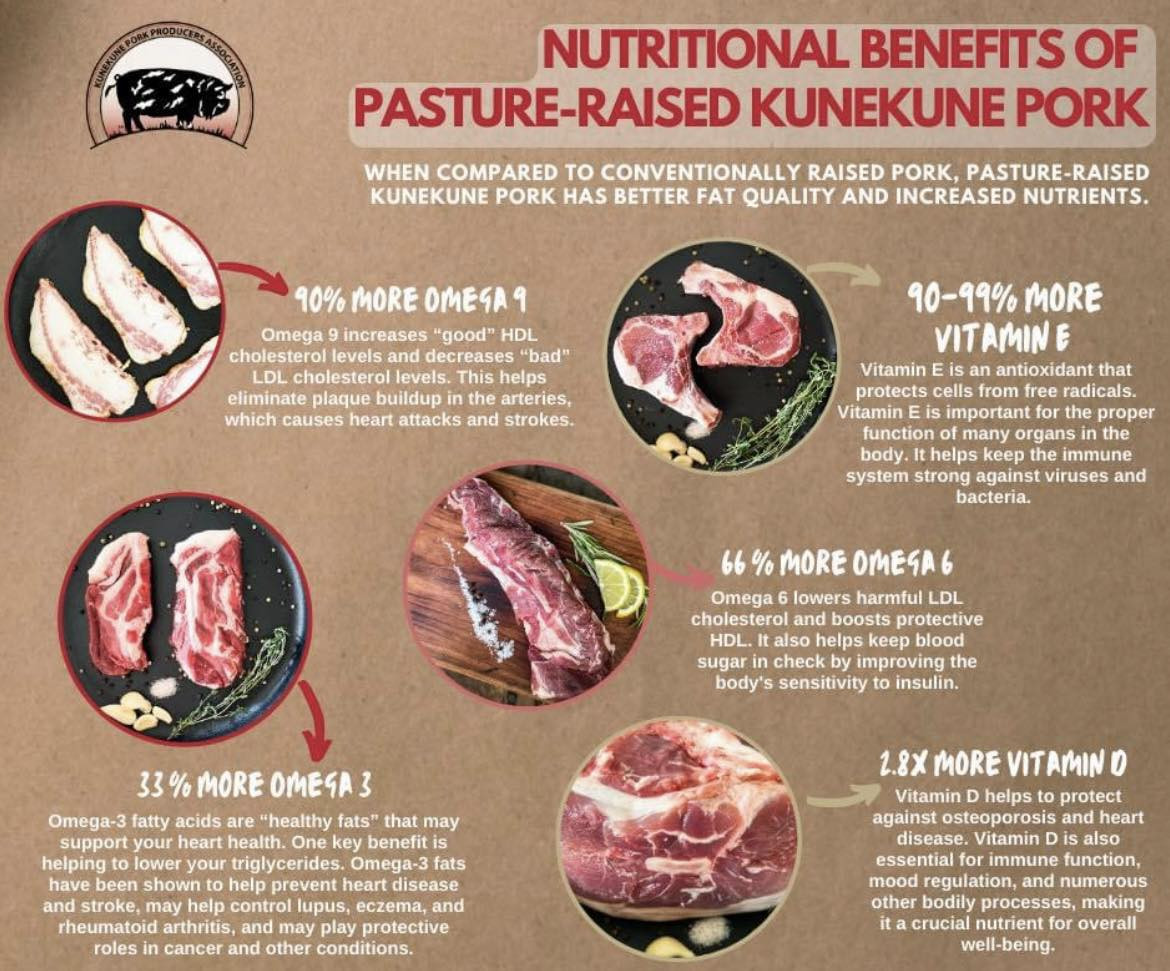
In 2023, the Empire Kunekune Pig Association (EKPA) commissioned blind laboratory testing comparing a commercial pork chop and a pasture-raised Kunekune pork chop. The samples were analyzed by an independent laboratory in Canada.
According to the published results, the pasture-raised Kunekune pork sample contained:
| Nutrient | Difference vs. Commercial Pork Sample |
|---|---|
| Vitamin E | 90–99% higher |
| Vitamin D | 2.8× higher |
| Omega-3 Fatty Acids | 33% higher |
| Omega-6 Fatty Acids | 66% higher |
| Omega-9 Fatty Acids | 90% higher |
Important Note:
These results represent the specific samples tested by EKPA/KPPA in 2023. Nutrient levels can vary based on genetics, diet, pasture availability, management practices, and individual animal variation.
Referenced from: Empire Kunekune Pig Association and Kunekune Pork Producers Association study published online.
More studies and findings on nutritional contents of conventional vs pasture raised pork can be found in the links below.
Heritage Breeds and Modern Pork
Modern commercial pig production has largely focused on:
- Faster growth
- Leaner carcasses
- Production efficiency
Heritage breeds like Kunekunes have often retained characteristics such as:
- Higher marbling
- Slower growth
- Rich flavor
- Traditional genetics
This doesn't automatically make one system healthier than another, but it does create a noticeably different eating experience.

Why Many Carnivore and Ancestral Diet Followers Choose Heritage Pork
Many people following carnivore, ancestral, or whole-food diets actively seek out heritage breed pork.
Common reasons include:
- Preference for higher-fat cuts
- Interest in pasture-based production
- Appreciation for traditional livestock breeds
- Desire to buy directly from local farms
Kunekune pork has become increasingly popular among these communities because of its flavor and fat quality.
Is Pastured Kunekune Pork More Nutritious?
The scientific answer is:
It depends.
Nutrition can vary based on:
- Genetics
- Feed program
- Pasture availability
- Age at harvest
- Individual animal variation
Without laboratory testing, it is difficult to make blanket claims about nutrient content.
What we can say is that many consumers choose pastured Kunekune pork because they value:
- Heritage genetics
- Pasture-based management
- Local food production
- Exceptional flavor
- Transparency in how their food is raised

Why We Raise Kunekunes at Dos Lobos Ranch
At Dos Lobos Ranch, our goal is not simply to produce pork.
Our goal is to raise pigs in a way that aligns with our values.
We chose Kunekunes because they offer:
- Excellent pork quality
- Rich flavor
- Beautiful marbling
- Pasture compatibility
- Heritage genetics
Whether you're interested in nutrition, animal welfare, local food, or simply finding better-tasting pork, Kunekune pigs offer something unique.

Frequently Asked Questions
Is Kunekune pork healthier than regular pork?
There is no simple answer. Nutrition depends on genetics, diet, management, and many other factors. Many consumers choose Kunekune pork because of its heritage genetics, marbling, flavor, and pasture-based production.
What makes pastured pork different?
Pastured pigs have access to outdoor environments where they can express natural behaviors such as grazing, rooting, and exploring.
Why do carnivore diet followers like Kunekune pork?
Many carnivore diet followers appreciate Kunekune pork because of its marbling, flavor, fat quality, and heritage genetics.
Is pasture-raised pork more natural?
Many consumers view pasture-raised pork as a more traditional production system because pigs have access to outdoor environments and natural behaviors.
Why does Kunekune pork taste different?
Kunekunes naturally develop more marbling and high-quality fat than many commercial breeds, contributing to their rich flavor and tenderness.
Has Kunekune Pork Been Nutritionally Tested?
In 2023, the Empire Kunekune Pig Association (EKPA) commissioned blind laboratory testing comparing a commercial pork chop and a pasture-raised Kunekune pork chop. The published results reported higher levels of Vitamin D, Vitamin E, and several omega fatty acids in the Kunekune sample that was tested. Results may vary depending on genetics, feed, pasture access, and management practices.
