

Preparing for a Kunekune Farrowing
Successful farrowing begins long before the first piglet arrives. Record the breeding date, estimate the due date at roughly 114 days (3 months, 3 weeks, 3 days), and prepare a clean, dry, draft-free space where the sow can settle without unnecessary stress.
Quick answer: Watch the sow closely as her udder fills, nesting increases, and behavior changes. Most sound Kunekune sows deliver naturally, but calm observation and a prepared emergency plan protect both sow and litter.
- Confirm the expected farrowing window from breeding records.
- Prepare a secure pen and build crush rails for it.
- Provide shallow, clean bedding using pine shavings or straw (we prefer pine shavings for easy mucking and odor control).
- Prepare clean towels, gloves, lubricant, iodine, a thermometer, and a safe warming area.
- Keep veterinary contact information available before labor begins.
- Work with your veterinarian to have prescription medications on hand should any common issues arise post-farrowing such as mastitis, uterine infection, retained placentas, etc.
- Feed lots of Tums! We start feeding 4-6 Tums per day leading up to farrowing and after to make sure the sow has enough calcium to avoid getting milk fever. Milk fever is not fun, especially if you don't know what it is and your vet doesn't either! Ask us how we know.
- Sow nutrition needs to be top priority. Upon knowing your pig is pregnant, feed her a high quality sow formula with an appropriate sow mineral packet mixed into the batch by your feed mill. This will help with overall health, farrowing, and nursing.
Observe the Sow
Most sows will feverishly begin nesting within 2-6 hours of delivery. She will gather shavings, straw, hay and other materials into a nice, neat pile in anticipation of arrival of piglets. When she's ready, she'll lay down and become still and focused, ready to start pushing. Sometimes she'll begin right away while other sows may take another hour or two before beginning active labor.
Delivery
Piglets can be born either nose first or breech. The sow will generally be able to quickly pass each piglet without intervention. Some piglets come quickly, one after another while other sows may have a 5 minute pause between piglets. A smooth labor will last 3-4 hours. A rockstar sow will have all piglets out within an hour. A difficult labor will generally extend beyond 3-4 hours and you will need to get ready to start taking steps to intervene.
Dip piglets navels in iodine to disinfect the umbilical cord. I prefer to tear the cords to about 3-4 inches from the piglet's navel. I've heard horror stories of sows stepping on piglets umbilical cords and ripping their innards out, so we always manage the umbilicals. Keep dental floss in your tool kit in case you have an umbilical that continues to bleed out uncontrollably so you can tie off the cord. Tying it in a knot if it's long enough can also work, too if you don't have anything on hand to tie it with. The iodine will dry out the umbilical within a few hours so that it's clean and out of the way.
The Pause Between Horns
The uterus of a pig is separated into two horns. Generally, the sow will move piglets out of one horn, then have a 30-45 minute pause before moving piglets out of the other horn. We've had some sows have no pause and just evacuate all piglets quickly and we've had some sows have a pause as long as 1.5 hours. I generally glove up and go in if we go beyond an hour pause and start feeling for a stuck or malpositioned piglet.
Passing the Placenta
The placenta can come out whole or in pieces throughout labor or at the very end. Glove up and check for any holes or indication that anything may be retained. The placenta will be thin, so don't be surprised when it easily tears in your hands. You can also count nodes on the placenta where umbilical cords were attached to give you an indication if all piglets are indeed out.
Complications
There are litany of complications that can arise from labor and delivery. Things to watch out for are nervous and agitated sows, sow hysteria, and other behavior issues, especially from a first time mama. Other issues can be exhaustion and the sow no longer able to push or piglets being too big, stuck, or malpositioned.Medications to Have On-hand
Have medications both over the counter (calcium gluconate) and prescription from your vet (oxytocin with their guidance on dosage) in case the sow tires out and quits pushing. Oxy can cause severe damage if misused. You will need A LOT of calcium gluconate (30-60 mL) per injection if she won't push anymore. The problems we've run into with calcium gluconate is usually you get diminishing returns with it as her system becomes saturated with it and eventually, even that will no longer help her push. Situation dependent, it may be best to get the prescription for the oxy and use it as a last resort.When to Pull Piglets
When the sow is pushing very hard without presentation of the piglet after 15 minutes is usually when I glove up and go in and start feeling around. Make sure to use lube from the feed store on your glove, and yes, buy with big long sleeve OB gloves. If she's pushing that hard, she'll likely not fight you as you go in, though it will be uncomfortable for her. The person with the skinniest arms in your household will be the best option for the sow -- I know farmer Richard would not be able to get his massive forearms into a Kunekune sow if he ever had to. I can't go any further beyond my elbow because my biceps are in the way, so you can likely expect the same. Just remember to go slow, close your fingers in closely together and make sure your fingernails are trimmed short before you know your sow is about to farrow.Experience is the Best Teacher
The more farrowings you observe, the more you'll understand what normal labor is and what requires your intervention. The more hard and difficult labors you see, the more you'll be able to recognize when to act and when to let the sow try to do it on her own. It's definitely a trial by fire and can be incredibly intimidating. As mentally difficult as it may seem, you'll be better for it, and you'll feel pretty proud that you were able to help your sow when she needed it most. After you get a few farrowings under your belt, you'll have plenty of confidence for the future.
Newborn Piglet and Post-Farrowing Care
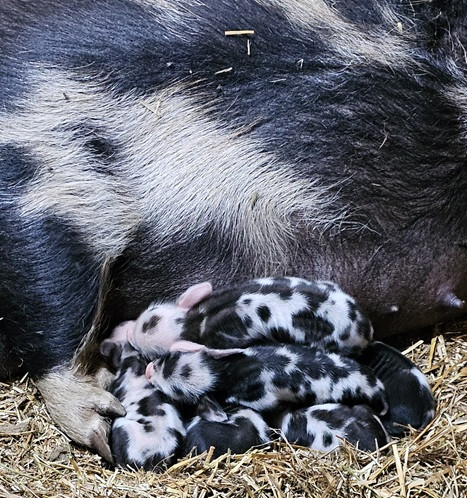
Clear membranes from each piglet’s nose and mouth, dry chilled piglets, and confirm that every piglet reaches a functional teat and consumes colostrum. Small or slow piglets may need help finding a teat without being separated from the sow longer than necessary.
- Keep piglets warm while leaving the sow comfortably cool.
- Check that the sow is calm, drinking, and allowing nursing.
- Count piglets and examine them for injury, weakness, or congenital problems.
- Watch for excessive bleeding, fever, poor appetite, foul discharge, mastitis, or failure to pass placental material.
- Recheck the litter frequently during the first 24 to 48 hours for chilling, starvation, or crushing risk.
Good records—birth order, sex, weight, markings, vigor, teat access, and any assistance—help evaluate future breeding decisions and maternal performance.

The First 24 Hours
Watch to make sure the sow is being careful with her piglets when she lays down. If she lays on one when you're not there, there's not much you can do about it other than make a note of it and see if the behavior continues to repeat at subsequent farrowings. A careful sow will lay down chest first in downward dog and then slowly lower her rear down. A reckless or overly exhausted sow will just flop over on her side. We've had careful sows get tired and careless after a few days and still nail a piglet.
Provide a pan of fresh, clean water in the piglet creep area for the piglets from day 1. We've never seen any of our litters drink water until about 3 weeks, but other breeders state that it's necessary from day 1.
Watch to make sure the piglets are eating and getting enough. Supplement via syringe only when you have to. We've never had to raise orphaned piglets, but it looks like hell. Youtube, Youtube, Youtube if you have to do that.
The First 3 Days
By day 3, the piglets should be nice and fat with full, round bellies. It's at this time that you'll need to give them iron injections as newborn piglets are very susceptible to anemia. Follow instructions on the bottle, but generally, it will call for 1 mL per piglet injected into either the neck or ham. We used to do the neck until we paralyzed one piglet on accident when we got too close to the spinal cord and another one came close, but resolved itself back to normal after an hour of uncontrolled shaking. You will not ruin the ham at butcher. It's better to risk the ham than paralyzing a piglet, especially a thin/weak one with no muscle mass in its neck. Use a 22 gauge butterfly needle no more than 1 inch long and do not insert all the way. 1/4 of an inch will do.
The First 2 Weeks
This is the period where we watch for hernias in piglets (both inguinal/scrotal and umbilical). Both males and females can get hernias. Keep handling of the piglets to a minimum. Some breeders think that some piglets get hernias through excessive handling by children and some piglets are just so delicate that as the piglets grow and start fighting for dominance in the litter that they'll accidentally tear a weak lining and herniate.The First 8 Weeks
By week 8, piglets are usually eating mom's food on their own and her milk is starting to dry off on its own. It's at this time that we'll wean the piglets and send them to their new farms or move them into our grow out herd for meat. We've done both gradual weanings a few hours at a time each day in increasing increments and cold turkey. The piglets seem to do just fine with cold turkey at 8 weeks, so that's what we go with.
Turn Every Farrowing Into Better Herd Records
Record the breeding date, farrowing date, labor length, birth order, litter size, piglet weights, presentations, assistance provided, and the sow’s maternal behavior. Those details help you recognize what is normal for each sow, prepare more confidently for future litters, and make better long-term breeding decisions.
After the litter is stable, continue monitoring the sow’s appetite, temperature, udder, discharge, and milk production while tracking piglet vigor, growth, teat access, and any health concerns through weaning. Review these records before planning the sow’s next breeding.
Continue with how to plan a Kunekune breeding pair and The Complete Guide to Kunekune Genetics and Breeding.

Frequently Asked Questions
How long is a Kunekune sow pregnant?
Kunekune gestation averages about 114 days—often remembered as three months, three weeks, and three days. Use the recorded breeding date to establish a farrowing window rather than relying on one exact due date.
What are the signs that a Kunekune sow is close to farrowing?
Common signs include a filling udder, enlarged teats, nesting, restlessness, reduced appetite, and eventually becoming quiet and focused before active pushing. Observe the sow’s normal behavior so changes are easier to recognize.
When should I intervene during a difficult farrowing?
Seek experienced or veterinary help when the sow is straining hard without producing a piglet, when the interval between piglets becomes unusually long for that sow, when a piglet appears stuck or malpositioned, or when the sow shows exhaustion, distress, fever, excessive bleeding, or foul discharge. Oxytocin and other medications should be used only with veterinary guidance because they can cause serious harm when used incorrectly.
What should I check during the first 24 hours after birth?
Confirm that every piglet is warm, breathing normally, nursing, and receiving colostrum. Check navels, watch for chilling or crushing risk, and monitor the sow for drinking, appetite, calm maternal behavior, milk production, excessive bleeding, fever, mastitis, or signs of retained placental material.